The weight of self-loathing can feel incredibly heavy, making even simple daily tasks seem insurmountable. Feeling intense dislike for yourself is an isolating experience, but you are far from alone in this struggle.
Many people face this internal battle silently. The good news is that self-hatred is a learned behavior, not an innate characteristic. Because it is learned, you can unlearn it. The journey toward self-acceptance requires time, effort, and immense patience, but moving past these negative feelings is entirely possible.

This guide on how to cope with self loathing offers actionable psychological strategies and self-compassion techniques to help you navigate your way toward a healthier relationship with yourself.
What are the Benefits?
Addressing and overcoming self-loathing profoundly transforms every aspect of your life. When you stop fighting a war against yourself, you unlock a new level of emotional freedom.
First, your mental health improves significantly. Constant self-criticism keeps your nervous system in a state of high alert, driving anxiety and feeding depressive symptoms. By softening your internal voice, you reduce this chronic stress. You will find that you sleep better, have more energy, and experience fewer mood swings.
Second, your relationships with others will flourish. Self-loathing often makes you push people away because you feel unworthy of love or fear rejection. As you begin to accept yourself, you naturally allow others to care for you. You become more authentic in your connections, leading to deeper, more meaningful bonds with friends, family, and romantic partners.
Third, your resilience in the face of failure increases. When you loathe yourself, a single mistake feels like absolute proof of your worthlessness. When you replace self-hatred with self-compassion, you learn to see mistakes as normal human experiences. This allows you to bounce back faster, learn from your errors, and keep moving forward without paralyzing shame.
Finally, your overall productivity and motivation will increase. When you no longer waste emotional energy tearing yourself down, you have more mental resources available to pursue your goals, hobbies, and passions. You start making choices based on what you want out of life, rather than what you feel you deserve.

What Will You Need?
To embark on this journey, you will need to gather a few essential mental and practical tools.
- Willingness and Patience: You must be willing to confront uncomfortable feelings. Healing is not a linear process. You need the patience to forgive yourself when you stumble or revert to old habits.
- A Journal: Writing down your thoughts is one of the most effective ways to externalize and analyze your internal dialogue. You will need a private space to document your feelings, track your triggers, and practice reframing your negative thoughts.
- Self-Compassion: This is the most critical tool in your arsenal. You need to prepare yourself to extend the same kindness to yourself that you would offer a struggling friend.
- A Support System: You need people who can reflect your positive qualities back to you when you cannot see them. This might include trusted friends, family members, or support groups.
- Professional Support: While self-help strategies are incredibly valuable, deeply rooted self-loathing often stems from past trauma or underlying mental health conditions. A licensed therapist or counselor can provide tailored techniques and a safe space to process complex emotions.
10 Easy Steps on How to Cope With Self Loathing
Step 1: Acknowledge and Label Your Feelings
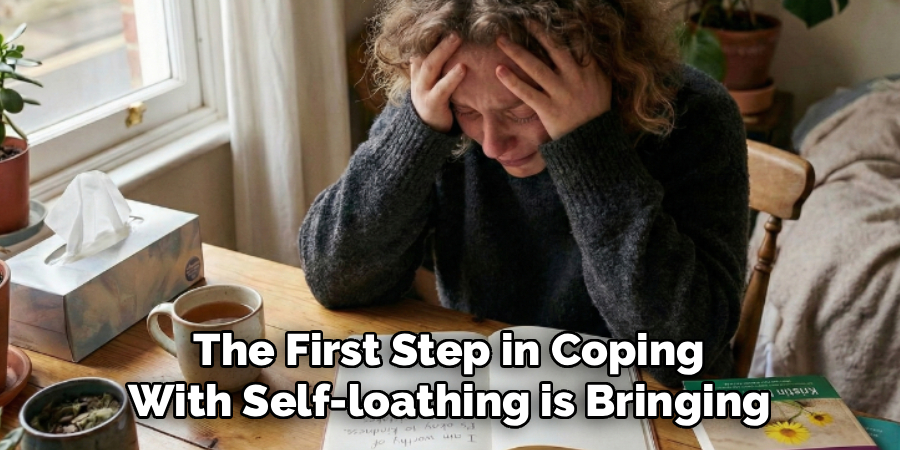
The first step in coping with self-loathing is bringing it out of the shadows. When the feeling strikes, pause and silently label it. You might say to yourself, “I am experiencing feelings of self-loathing right now.” By naming the emotion, you create a psychological distance between yourself and the feeling. You remind yourself that this is an emotional state you are passing through, not an objective truth about your character. Acknowledgment prevents you from unconsciously acting out of pain.
Step 2: Identify Your Specific Triggers
Self-loathing rarely exists in a vacuum; certain events or interactions usually activate it. Pay close attention to when these intense negative feelings arise. Do they happen after scrolling through social media? Do they occur when you make a minor mistake at work? Or perhaps they flare up after spending time with a particular person? Use your journal to track these instances. Understanding your triggers allows you to anticipate these feelings and prepare your coping mechanisms before the self-hatred spirals out of control.
Step 3: Challenge Your Negative Self-Talk
Your inner critic often speaks in absolutes, using words like “always” or “never.” When you catch yourself thinking, “I always ruin everything,” stop and challenge that statement. Demand evidence from yourself. Have you truly ruined everything? Think of three recent situations where you succeeded or handled things well. By cross-examining your inner critic like a lawyer in a courtroom, you quickly realize that your self-loathing thoughts are based on emotional distortions, not actual facts.
Step 4: Practice Active Self-Compassion
Self-compassion means treating yourself with the warmth and understanding you would offer someone you love. When you make a mistake, notice how you respond. Instead of punishing yourself, consciously shift your language. Tell yourself, “This is really hard right now, but I am doing my best.” Physical gestures can also help. Placing your hand over your heart while taking a few deep breaths can calm your nervous system and physically signal to your body that you are safe and cared for.

Step5: Separate Your Actions from Your Identity
People who struggle with self-loathing frequently confuse what they do with who they are. If you fail a test, the thought is not “I failed,” but rather “I am a failure.” You must practice separating your behaviors from your core identity. A poor decision or a mistake is an event; it does not define your worth as a human being. Remind yourself daily that your value is inherent and unconditional. It does not fluctuate based on your productivity, your appearance, or your daily achievements.
Step 6: Limit Your Exposure to Unhealthy Comparisons
Comparison is the engine that drives self-loathing. In our modern environment, we constantly see the curated highlight reels of other people’s lives. Take a proactive stance by curating your environment. Unfollow accounts on social media that make you feel inadequate. Distance yourself from peers who constantly brag or make you feel less than. Replace these inputs with content that inspires you, educates you, or makes you laugh. Protect your mental space aggressively.
Step 7: Forgive Your Past Mistakes
Self-loathing often feeds on old regrets and past behaviors. You might constantly replay a cringeworthy moment or a poor choice from years ago. To move forward, you must practice self-forgiveness. Understand that the person who made those past mistakes was likely doing the best they could with the knowledge and emotional tools they had at the time. You have grown since then. Write a letter of forgiveness to your past self, acknowledging the pain but explicitly stating that you release the guilt.
Step 8: Establish and Enforce Healthy Boundaries
When you do not value yourself, you often let others mistreat you, which only reinforces the self-loathing. You must learn to set clear boundaries. This means saying “no” to unreasonable requests, protecting your free time, and walking away from conversations that demean you. Enforcing boundaries communicates a powerful message to your own brain: “I am worth protecting.” At first, this will feel incredibly uncomfortable, but with practice, setting boundaries becomes a cornerstone of self-respect.
Step 9: Focus on Small, Daily Wins
When you feel terrible about yourself, looking at the big picture can be overwhelming. Instead, shrink your focus to the present day. Set tiny, achievable goals. This could be as simple as drinking a glass of water, making your bed, or taking a five-minute walk. When you complete a task, consciously acknowledge it. Over time, these small wins build a foundation of self-efficacy and trust. You prove to yourself that you are capable and dependable, which naturally erodes feelings of worthlessness.

Step 10: Seek Professional and Structured Help
Sometimes, self-loathing is too deeply entrenched to dismantle on your own. Seeking the guidance of a professional therapist is an act of profound self-care. Modalities like Cognitive Behavioral Therapy (CBT) or Acceptance and Commitment Therapy (ACT) are highly effective at rewiring negative thought patterns. A therapist provides a non-judgmental mirror, helping you see the blind spots in your thinking. Reaching out for help is never a sign of weakness; it is a brave step toward reclaiming your life.
5 Things You Should Avoid
1. Avoid Isolation
When self-loathing peaks, your first instinct is usually to hide. You might cancel plans, ignore texts, and retreat into your own mind. Isolation creates an echo chamber where your negative thoughts bounce around unchallenged. Push yourself to connect with others, even in small ways. A brief conversation or a walk with a friend breaks the cycle of rumination.
2. Avoid Ruminating on the Negative
Rumination is the act of endlessly chewing on negative thoughts without ever finding a solution. It keeps you trapped in the past. When you notice you are spiraling into repetitive negative thoughts, force a pattern interrupt. Get up, change your physical environment, or engage in a task that requires intense mental focus.
3. Avoid Toxic Relationships
You cannot heal from self-loathing if you surround yourself with people who feed it. Avoid individuals who constantly criticize you, diminish your achievements, or use your insecurities against you. Prioritize relationships that uplift you. If you cannot entirely cut out a toxic person, strictly limit your interactions with them.
4. Avoid the Perfectionism Trap
Perfectionism is self-loathing in a nice suit. It is the belief that if you just do everything perfectly, you will finally be acceptable. Perfection is an impossible standard, meaning you will always fail, which gives your inner critic more ammunition. Strive for “good enough” instead. Embrace the messy, imperfect reality of being human.
5. Avoid Unhealthy Coping Mechanisms
It is tempting to numb the pain of self-hatred with alcohol, excessive junk food, or compulsive shopping. While these offer a brief escape, they ultimately make you feel worse in the long run, adding shame to your self-loathing. Lean on healthy coping strategies like exercise, deep breathing, or creative expression instead.
Conclusion
How to cope with self loathing is one of the most courageous things you can do for yourself. The journey requires you to face dark thoughts, challenge long-held beliefs, and show up for yourself even when you feel you do not deserve it.
Remember that you did not choose to hate yourself; it was a protective mechanism or a narrative you absorbed long ago. By reading this guide and applying these steps, you are already breaking that cycle. Treat yourself gently, celebrate your small victories, and do not hesitate to ask for help along the way.
You possess an inherent worth that nothing can diminish, and with time, you will learn to see it clearly.

About
Joe Herman is a distinguished figure in the world of personal development, with a decade of expertise creating innovative and sustainable self-improvement frameworks. His professional focus lies in merging cognitive behavioral strategies with modern productivity techniques, fostering habits that are both practical and mentally sustainable. As the lead author of selfvity, Joe Herman delves into the art and science of human potential, inspiring individuals and industry professionals alike to optimize their daily lives.
Education
Stanford University
(Stanford, California) Associate Degree in Behavioral Psychology — Focus on habit formation, cognitive restructuring, and peak performance. Gained hands-on experience with psychological assessment tools and data-driven behavioral modification.
University of Pennsylvania
(Philadelphia, Pennsylvania) Bachelor’s in Positive Psychology and Human Potential (Honors) — Specialized in the science of well-being with a focus on blending psychological theory with actionable growth techniques. Participated in extensive research projects, working with leading wellness consultants to gain real-world insights into human motivation.
Publications and Impact
In selfvity, Joe Herman shares his insights on internal growth processes, mental material, and strategies for efficient lifestyle design. His writing bridges the gap between scientific research and everyday application, making it a must-read for both individuals seeking personal clarity and seasoned professionals looking to refine their mental edge.