Bitterness rarely stays neatly contained. It tends to spill into ordinary life—into conversations, private thoughts, even quiet moments that should feel restful. Maybe you find yourself replaying an old argument in the shower, or returning yet again to the same sense that something unfair was done to you. That reaction is understandable. Still, carrying unresolved resentment often harms the person holding it more than the person who caused it.

None of this means you should dismiss what happened or force yourself into fake positivity. It means that if you want more ease, more clarity, perhaps even more emotional steadiness, you may need to work with the anger rather than orbit around it. What follows is a practical guide: not a miracle cure, and not a demand to “just move on,” but a set of grounded steps that can help you process hurt and loosen resentment’s grip. In this guide on how to stop being bitter, we will explore various ways to deal with negative emotions and cultivate more peace in our lives.
Understand the Root Causes of Bitterness
If you want to deal with bitterness, it helps to ask where it actually comes from. In most cases, resentment does not appear all at once. It builds. A slight goes unaddressed. A betrayal is minimized. An expectation collapses, and no one names the loss. Over time, what began as hurt may harden into something more durable and more corrosive.
That hardening matters. When pain is left unprocessed, people often start interpreting new experiences through the old wound. A delayed text feels like rejection. Criticism feels personal. Someone else’s success may stir resentment that seems, on the surface, unrelated. So the first task is not to condemn yourself for feeling bitter. It is to understand the sequence: hurt, suppression, repetition, then bitterness. That understanding does not solve the problem by itself, but it does give you somewhere real to begin.
7 Simple Step-By-Step Guidelines on How to Stop Being Bitter
Step 1: Acknowledge Your Feelings
Healing usually starts in a less glamorous place than people expect. Not with insight. Not with forgiveness. With honesty. You have to admit what you feel before you can do much with it. If you keep insisting that you are “fine” when you are plainly angry, hurt, or humiliated, those feelings do not disappear; they simply go underground.
Try naming what is there without editing it. You may feel rage, envy, sadness, shame, or some uneasy mix of all four. Writing in a private journal can help. So can speaking out loud when you are alone. The point is not performance. The point is contact.
As you begin doing this, you might notice that emotion has a physical side. A clenched jaw. A knot in the stomach. Shoulders that rise before you even realize you are tense. Those signals can be useful. They often appear before the familiar mental spiral does, which means they can become an early warning system. That is not trivial. Catching resentment early may make it easier to interrupt.

Step 2: Identify the Source of Your Anger
Once you admit that something is wrong, the next question is obvious and surprisingly difficult: what, exactly, are you angry about? Not the polished version you tell other people. The actual source. Sometimes it is clear—a betrayal, a public embarrassment, repeated disrespect at work. Just as often, though, the first answer is incomplete.
You might think you are furious about one rude comment from a partner when what really hurts is a long-standing feeling of being unseen. Or you may blame a single incident at work when the deeper issue is cumulative: being overlooked, talked over, and then expected to stay agreeable. That distinction matters. If you misidentify the wound, you may spend months treating the symptom.
Sit with the specifics. What happened? When did the bitterness begin to gather force? What expectation was broken? In some cases, the anger is less about the event itself than what it seemed to say about your worth, safety, or place in the relationship. Once that becomes clearer, your next steps are likely to be more precise and more useful.
Step 3: Practice Empathy and Perspective-Taking
This step is often the one people resist, and for understandable reasons. If someone hurt you, trying to understand them can feel suspiciously close to excusing them. It is not the same thing. Empathy does not require you to deny harm. It asks only that you consider the possibility that another person’s behavior came from their limitations, fears, immaturity, or confusion—not necessarily from a grand plan to wound you.

Sometimes that shift changes everything. An offense that once felt deeply personal may begin to look like the consequence of someone else’s poor coping, emotional blindness, or lack of self-awareness. That does not make the injury unreal. It may, however, soften the belief that you were singularly targeted or that the event defines your value.
There is a caution here. Perspective-taking is helpful only if it does not become self-erasure. You are not obliged to narrate away harm in the name of being mature. The goal is not to excuse. It is to see more clearly. And clear seeing often gives resentment less fuel.
Step 4: Establish Healthy Boundaries
Bitterness has a way of growing where boundaries are weak, vague, or constantly violated. If you repeatedly allow treatment that leaves you drained, diminished, or on edge, resentment is not a mysterious outcome. It is, in many cases, a predictable one.
So boundaries matter. Not as a fashionable concept, but as a practical one. You need to know what you will accept, what you will no longer negotiate, and what you plan to do if those lines are crossed. That last part is important. A boundary without follow-through is closer to a wish than a limit.
This may feel awkward at first, especially if you are used to smoothing things over or avoiding conflict. Saying no can bring guilt. Pulling back from someone can feel harsh, even when it is necessary. Yet a workable boundary often creates the very conditions bitterness needs in order to loosen: safety, predictability, and less exposure to repeat injury. You are not punishing others by setting limits. You are reducing the likelihood of becoming quietly resentful all over again.
Step 5: Focus on What You Can Control
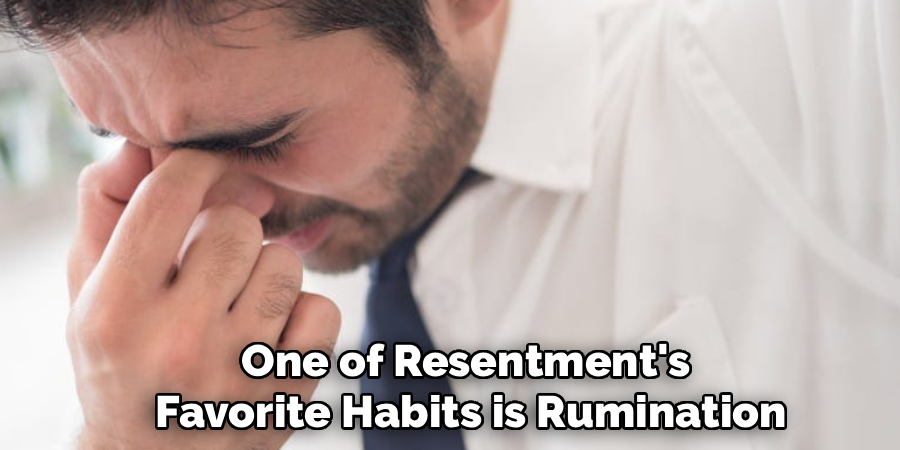
One of resentment’s favorite habits is rumination. It keeps returning to the same closed door: what should have happened, what someone else ought to admit, what you wish you had said in the moment. The mind can spend years there. The problem is that this kind of mental rehearsal rarely repairs anything.
There are things you cannot control. The past is one of them. Other people’s motives, remorse, and level of self-awareness belong on that list, too. What remains, and it is not insignificant, is your own response. You can decide where your attention goes today. You can change habits, seek support, end contact, build stronger routines, rest more, and speak more plainly.
That shift from fixation to action is often less dramatic than self-help writing makes it seem. It may look like going for a walk instead of rereading old messages. It may mean applying for a new position rather than continuing to stew over a toxic manager. Sometimes it is as basic as eating, sleeping, and talking to one trustworthy person before your thoughts harden into a narrative. Small acts of agency do not erase injury, but they can interrupt helplessness. That, in itself, can be stabilizing.
Step 6: Practice Forgiveness for Yourself and Others
Forgiveness is one of those words that tends to arrive carrying too much baggage. People hear it and assume it means approval, reconciliation, or moral surrender. In practice, forgiveness may be something more restrained and more inward. It can mean deciding that you no longer want your life organized around an old injury.
That does not happen on command. In some cases, forgiveness comes slowly, in increments. In others, it may never take the sentimental form people expect. Still, releasing the demand that the past be different—or that the other person finally provide a satisfying apology—can create some room to breathe.
Self-forgiveness deserves equal attention. Many people are not only bitter at others; they are quietly furious with themselves. They missed warning signs. Stayed too long. Trusted too quickly. Said yes when they wanted to say no. Looking back, they judge themselves with information they only gained afterward. That is a hard standard to live under. A more humane view might be this: you made choices with the understanding, fear, hope, or loneliness you had at the time. Recognizing that may not remove regret, but it can reduce the cruelty of endless self-reproach.
Step 7: Cultivate Gratitude Daily
Gratitude can sound flimsy when discussed alongside real pain. Used badly, it becomes a way of avoiding difficult emotion: focus on the good, ignore the wound. That version is not especially helpful. A more serious practice of gratitude does something else. It widens attention.
When you are bitter, your mind often scans for proof that life is unfair, people are disappointing, and nothing truly changes. Gratitude gently counters that habit by asking you to notice what is still decent, sustaining, or unexpectedly kind. That could be a friend’s text. A quiet morning. A meal you did not have to rush through. Nothing grand is required.
Try writing down a few specific things each day. Not because this guarantees happiness, and not because misery is a personal failure, but because attention is trainable. Over time, you may find that your inner landscape changes a little. The old injury is still part of your history, but it no longer occupies every inch of mental space. Often, that is how healing begins to become visible—subtly, then all at once. Following these steps on how to stop being bitter can help you start to let go of negative feelings and move towards a more positive outlook on life.
Common Mistakes to Avoid
One common mistake is expecting progress to move in a straight line. It usually does not. You may feel calmer for two weeks and then, after one stray reminder, find yourself angry all over again. That can feel discouraging, though it does not necessarily mean you are back at the beginning. Old pain often resurfaces in layers.
Another trap is waiting for an apology before allowing yourself relief. Sometimes apologies come. Sometimes they are partial, self-serving, or years too late. Sometimes they never arrive. If your healing depends entirely on another person’s insight or remorse, you remain tied to their timetable. That can keep resentment alive far longer than it needs to be.

Develop Long-Term Emotional Healing Habits
If you want bitterness to loosen for good, or at least not return so easily, daily habits matter. Not because routines solve everything, but because emotional life is shaped by repetition. Sleep deprivation, chronic stress, isolation, and unprocessed conflict can all make resentment easier to sustain.
Simple practices help more than people sometimes want to admit. Regular movement can lower tension. Journaling may help you track recurring triggers rather than being blindsided by them. Mindfulness, if it suits you, can make it easier to notice a thought without immediately becoming absorbed in it. None of these is a cure. They are supporters.
The people around you matter too. If your social world rewards grievance, gossip, or constant outrage, bitterness may feel oddly justified and strangely hard to release. By contrast, spending time with people who are steady, honest, and not addicted to drama can have a regulating effect. Emotional health is personal, yes, but it is also relational. That point is easy to overlook.
When to Seek Help?
There are situations where self-help tools may not be enough. If resentment is entangled with trauma, abuse, major loss, or years of relational injury, the work can be more complicated than a journal and a few mindset shifts can address. That is not failure. It is simply a scale.
Consider professional support if anger is affecting your sleep, your concentration, your work, or your ability to trust anyone without bracing for harm. A licensed therapist or counselor may be able to help you identify patterns, challenge rigid beliefs, and process experiences that still feel emotionally unfinished. In some cases, structured approaches such as cognitive-behavioral therapy can be useful. The point is not to hand your life over to an expert. It is to recognize when outside guidance could make the process safer, clearer, or more effective.
Moving Forward With a Lighter Heart
Letting go of bitterness is rarely a clean, inspiring transformation. More often, it is uneven work. Quiet work. At times, it feels unfair that you have to do so much labor around pain you did not choose. That critique is worth keeping in view. Even so, if resentment is shaping your days, there is real value in beginning.
You do not need to master every step at once. Start where the pressure feels highest: naming the hurt, setting one boundary, loosening one old story, asking for help. Over time, those choices may add up to something substantial—a mind that feels less crowded, relationships that are less defensive, a life no longer organized around an injury. And if the process feels too heavy to carry alone, reaching out to a licensed therapist is not a last resort. It may simply be the next sensible step. Thanks for reading this guide on how to stop being bitter.

About
Joe Herman is a distinguished figure in the world of personal development, with a decade of expertise creating innovative and sustainable self-improvement frameworks. His professional focus lies in merging cognitive behavioral strategies with modern productivity techniques, fostering habits that are both practical and mentally sustainable. As the lead author of selfvity, Joe Herman delves into the art and science of human potential, inspiring individuals and industry professionals alike to optimize their daily lives.
Education
Stanford University
(Stanford, California) Associate Degree in Behavioral Psychology — Focus on habit formation, cognitive restructuring, and peak performance. Gained hands-on experience with psychological assessment tools and data-driven behavioral modification.
University of Pennsylvania
(Philadelphia, Pennsylvania) Bachelor’s in Positive Psychology and Human Potential (Honors) — Specialized in the science of well-being with a focus on blending psychological theory with actionable growth techniques. Participated in extensive research projects, working with leading wellness consultants to gain real-world insights into human motivation.
Publications and Impact
In selfvity, Joe Herman shares his insights on internal growth processes, mental material, and strategies for efficient lifestyle design. His writing bridges the gap between scientific research and everyday application, making it a must-read for both individuals seeking personal clarity and seasoned professionals looking to refine their mental edge.